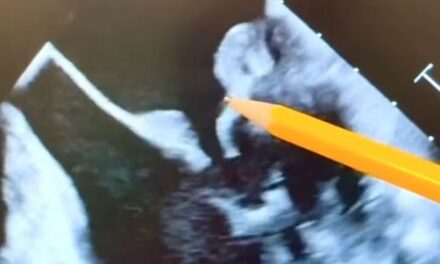
Have you ever heard of the term pericarditis and wondered, “What the heck is this all about?” Because we’re hearing a lot about it lately with vaccines. I’m going to explain all this to you in a little bit of a long video, so sit tight.
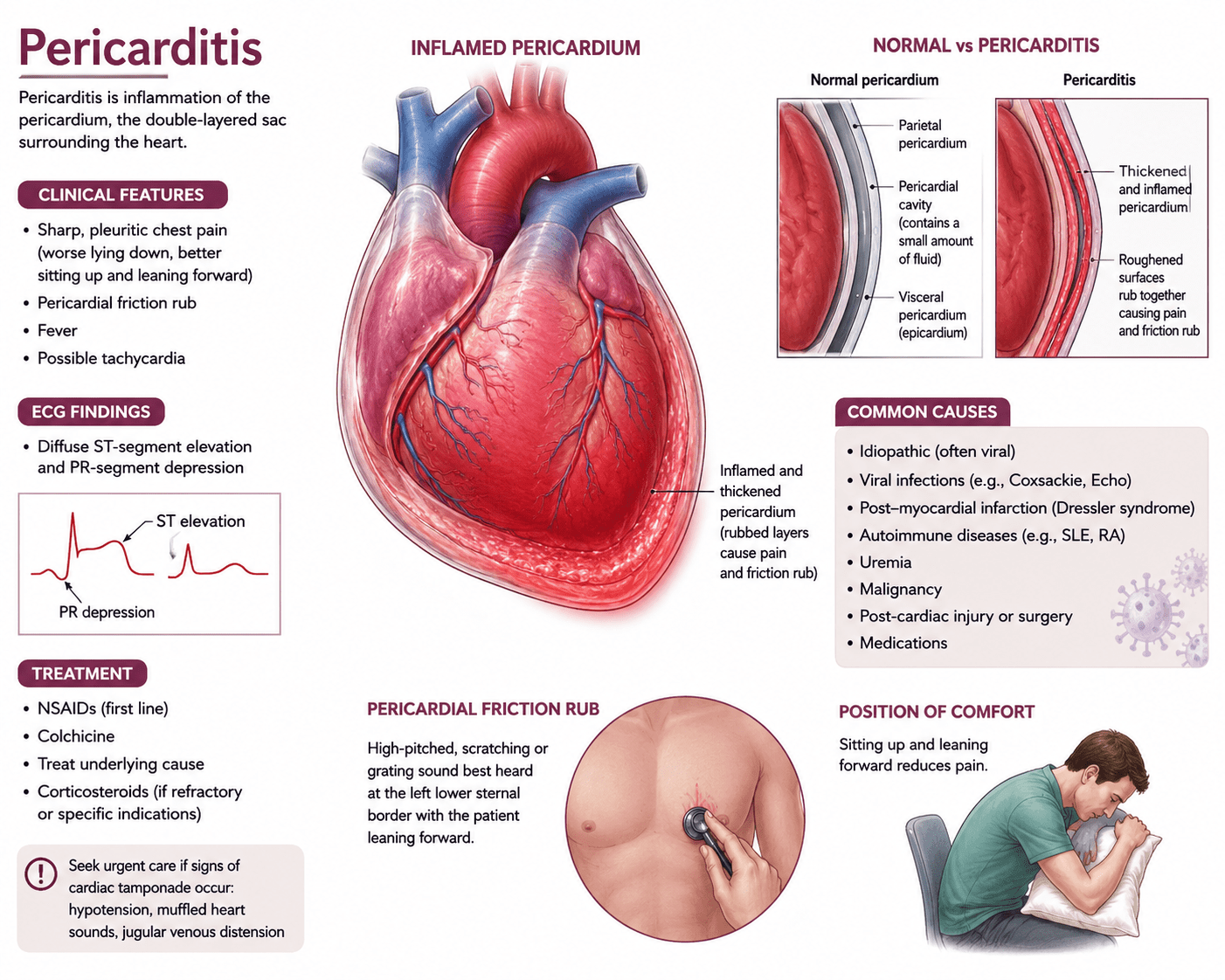
Pericarditis is inflammation of the pericardium, which is the sac that the heart sits in. Normally, the heart and the pericardium slide smoothly against each other, but when they become inflamed, they can rub together, causing chest pain and other symptoms.
The most common symptom is, in fact, very sharp chest pain that often gets worse when you’re taking a deep breath or lying flat and may actually improve when you sit up and lean forward. Some patients also experience shortness of breath, fatigue, fever, or palpitations.
So let’s start by talking about the several different types of pericarditis. Then we’ll talk about the causes and the treatment.
Acute pericarditis is the most common form. It develops acutely, suddenly, and often resolves within a few days or a few weeks.
Recurrent pericarditis occurs when symptoms return after the initial episode has improved. So it keeps coming back.
Chronic pericarditis is more persistent. It can last for months or even years. A less common but very serious form of chronic pericarditis is known as constrictive pericarditis, where the pericardium is so thick and scarred that it can actually restrict the heart’s ability to fill normally. In severe cases, surgery may be required to strip the pericardium off the heart.
So what causes this? What causes pericarditis?
Well, I’ll be honest with you. In most patients, the exact cause is never identified. We call that idiopathic pericarditis. However, many cases of idiopathic pericarditis are believed to be triggered by viral infections, so that’s a key point here.
Now, there are other causes, including autoimmune diseases such as lupus, rheumatoid arthritis, kidney failure, certain medications, cancer, chest trauma, radiation, and yes, even heart surgery, which is what I do.
In fact, pericarditis is relatively common after cardiac surgery, and it’s known as post-pericardiotomy syndrome, or Dressler syndrome.
So how do we diagnose it?
Doctors use a combination of the patient’s symptoms, physical examination, electrocardiograms or EKGs, certain blood tests that look for inflammation, and echocardiography, which is very important. Occasionally, we’ll use CT scans or even MRI studies.
Well, once you have it, how do you treat it?
The treatment depends on the cause and the severity. For most patients, anti-inflammatory medications are the cornerstone of treatment. These include ibuprofen, aspirin, and other nonsteroidal anti-inflammatory drugs.
A medication known as colchicine, which some people with gout are familiar with, has become an important part of treatment because it helps reduce inflammation and may lower the risk of recurrence.
In patients with recurrent or difficult-to-treat pericarditis, steroids or newer immunomodulating therapies may be used.
Now, here’s an important thing. If fluid accumulates around the heart, which it can with pericarditis, it can impair the function of the heart. A procedure called pericardiocentesis, in which a drain is placed percutaneously, or even a surgical procedure known as a subxiphoid pericardial window, may be needed to drain that fluid.
So let’s talk about the elephant in the room, and that is: can vaccines cause pericarditis?
The answer is yes, but it’s actually more uncommon than you might think.
Cases of pericarditis and myocarditis, which is inflammation of the heart muscle itself, have been reported after several vaccines over the years. This is actually nothing new.
Some of those vaccines include the smallpox vaccine and, more commonly, the COVID-19 vaccines.
So let’s talk about that.
With the mRNA COVID-19 vaccines, the risk appears to be highest among adolescent and young adult males, typically occurring within a few days after vaccination.
Fortunately, most reported cases have been mild and have resolved with treatment and rest.
But let’s keep it in perspective. COVID-19 infection itself, which is still around, can cause pericarditis. It can cause myocarditis. It can cause blood clots, heart attacks, and many other cardiovascular complications.
In fact, the risk of heart inflammation from the infection is higher than the risk associated with vaccination.
As physicians, we continue to monitor the data carefully, but the overwhelming evidence suggests that serious vaccination-related pericarditis is rare. For most individuals, the benefits of vaccination have clearly outweighed the risk of getting the disease.
The bottom line is this:
Pericarditis is inflammation of the sac surrounding the heart. Most cases are treatable. Many resolve completely. With proper diagnosis and management, the vast majority of patients do well regardless of the cause, including vaccination-related pericarditis.
That’s a lot.
Interested in my book? You can buy it on Amazon!
(𝘛𝘩𝘦 𝘷𝘪𝘦𝘸𝘴 𝘦𝘹𝘱𝘳𝘦𝘴𝘴𝘦𝘥 𝘪𝘯 𝘮𝘺 𝘱𝘰𝘴𝘵𝘴 𝘢𝘳𝘦 𝘮𝘺 𝘰𝘸𝘯 𝘢𝘯𝘥 𝘥𝘰 𝘯𝘰𝘵 𝘳𝘦𝘱𝘳𝘦𝘴𝘦𝘯𝘵 𝘵𝘩𝘦 𝘷𝘪𝘦𝘸𝘴 𝘰𝘧 𝘮𝘺 𝘦𝘮𝘱𝘭𝘰𝘺𝘦𝘳 𝘰𝘳 𝘢𝘯𝘺 𝘰𝘳𝘨𝘢𝘯𝘪𝘻𝘢𝘵𝘪𝘰𝘯.)
Recent Posts

The Power of Culture in Healthcare: Why Great Teams Deliver Better Care
In healthcare, metrics tell only part of the story. The culture behind a program shapes how people communicate, collaborate, hold one another accountable, and ultimately care for patients.

A Tiny Heart Tumor, a Stroke, and a Remarkable Recovery
After suffering a stroke with no clear source, Tayshia Hatcher was found to have a small tumor on her aortic valve. Surgeons removed the benign tumor, preserved her valve, and helped identify what was likely the source of her stroke. Six weeks after surgery, Tayshia reported no pain and no lasting effects from her stroke.

When Open Heart Surgery Is the Best Option
At 82 years old, Rachel Leister underwent triple valve open heart surgery after severe aortic and mitral valve stenosis caused significant shortness of breath. Six weeks later, she is pain-free, feeling great, and ready to get back to walking outdoors.

Your Heart Was Made to Move
What is the best exercise for your heart? There isn’t just one answer. Dr. Raymond Singer explains how aerobic exercise, strength training, flexibility, balance, and simple daily movement can all support cardiovascular health.

Can Sleep Affect Your Waistline?
We often think about diet and exercise when we talk about maintaining a healthy weight. But there may be a third piece of the puzzle: sleep. Dr. Raymond Singer explores how insufficient sleep can affect hunger, metabolism, cravings, abdominal fat, and cardiovascular health.

The Heart-Lung Machine: A Jefferson Legacy That Changed Medicine
More than 70 years ago, Jefferson surgeon and researcher John H. Gibbon Jr. helped make what once seemed impossible a reality: temporarily replacing the functions of the heart and lungs with a machine so surgeons could operate on a stopped heart.
Featured
Pages
- Learn about heart valves. Heart Valves
- Read testimonials. Testimonials
- Did you know I have a consulting firm? Singer Heart/Lung Consulting
- Check out my TedTalk! Defining Success
Links
- Links page with more information about your heart. Links
- Dr. Adam Pick's Site: heart-valve-surgery.com