Transcript
Good morning.
Doctor: Good morning. And your name is?
Michael: Michael Rothis.
Doctor: And we have your permission to videotape you?
Michael: Yes.
Doctor: And if we place this on our website or social media for educational purposes, that would be okay?
Michael: Yes.
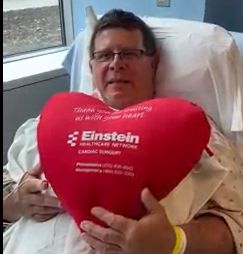
Doctor: You are now 30 days after open-heart surgery, coronary artery bypass grafting times two. What brought you to see Dr. Hugh Lipschitz for your coronary artery disease? What happened?
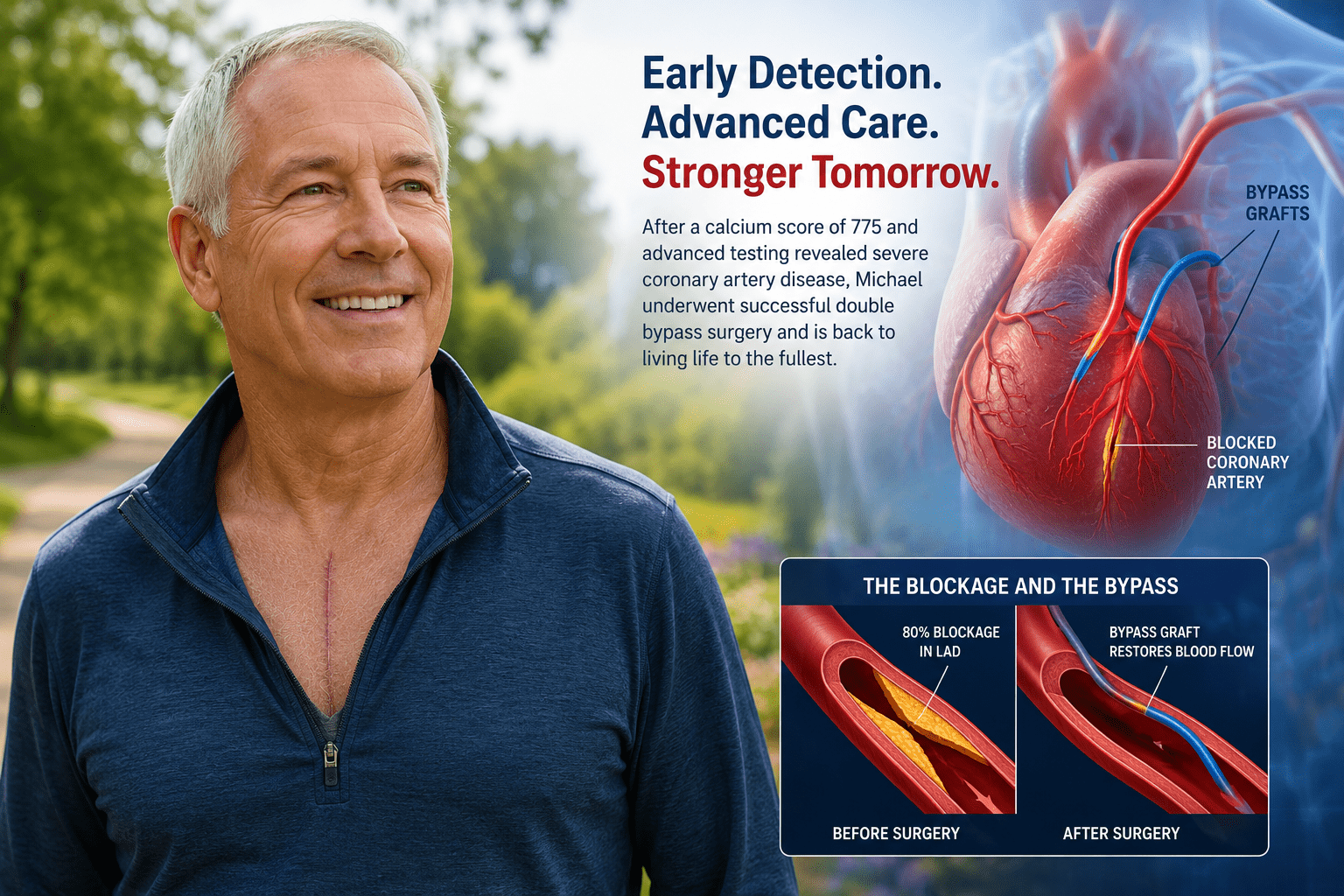
Michael: In 2021, because my good buddy had the calcium score test done and his score was 100, I thought that seemed awfully high. So I got mine done, and it came back at 775.
However, during my most recent stress test in February of this year, Dr. Lipschitz performed a PET stress test, which is a specialized imaging study. The results showed that my blood pressure response during stress was blunted, meaning my blood pressure did not rise the way it should during exercise.
They knew something wasn’t right under stress conditions.
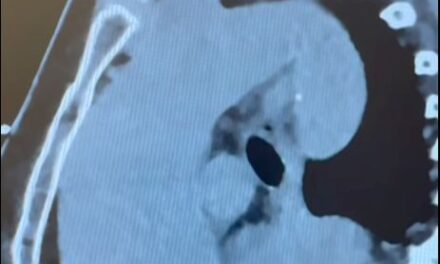
So we moved directly to cardiac catheterization to get a clearer picture of what was happening. That’s when they found an 80% blockage in the left anterior descending artery and significant blockages in two branches coming off the aorta.
Doctor: Right. And that’s why we performed coronary bypass grafting times two. The surgery took place just 11 days after the cardiac catheterization.
How do you feel now?
Michael: I feel great.
Doctor: Your surgery was on a Wednesday, and you went home on Sunday, correct?
Michael: Correct.
Doctor: And now it’s four weeks later. Talk about the pain.
Michael: Very minimal. Minimal pain.
Doctor: On a scale of one to ten, what would you rate it?
Michael: One.
Doctor: You also mentioned some numbness. The reason for that is we used a special pain-control technique called cryoablation of the intercostal nerves. We use a device from a company called AtriCure. For full disclosure, I have no relationship with the company, but we use their products because they allow us to proactively numb the area on both sides of the chest.
Describe where the numbness is.
Michael: It’s right along here and, of course, around the middle of the chest.
Doctor: But the tradeoff is that you’ve essentially had no pain.
Michael: That’s right. I’ve had no pain throughout the entire recovery.
Doctor: You also told me an interesting story about your grandfather’s experience with heart surgery when you were young.
Michael: Yes.
Doctor: That was many decades ago, in the early days of cardiac surgery.
Michael: Back then, it seemed like a chainsaw had gone through the chest. There was tremendous pain and a very long hospital stay.
Doctor: Times have changed. While many patients hear “heart surgery” and become worried, modern techniques have dramatically improved recovery. We have stents and minimally invasive procedures, but for patients who need open-heart surgery, it isn’t nearly as frightening as it once was.
Michael: Very true.
Doctor: Here we are only four weeks later, and you look fantastic.
Michael: Thank you.
Doctor: Would you like to show your incision?
Michael: Sure.
Doctor: As everyone can see, the incision is healing beautifully. It’s much smaller than many people expect. If you were wearing a V-neck shirt, it would hardly be noticeable.
Your bypass grafts look excellent. How was your care here at Jefferson Einstein Montgomery Hospital?
Michael: Excellent. Absolutely excellent.
Doctor: You were a wonderful patient to care for. Not only are you a success story because of the bypass surgery itself, but also because of the newer pain-management approaches that significantly reduce postoperative discomfort.
What message would you like to share with other patients?
Michael: If you need the surgery, don’t be afraid. Especially if you have “widowmaker” blockages like I did, don’t delay.
Doctor: Excellent advice. Thank you very much, and continued good luck to you.
Michael: Thank you.
Interested in my book? You can buy it on Amazon!
(𝘛𝘩𝘦 𝘷𝘪𝘦𝘸𝘴 𝘦𝘹𝘱𝘳𝘦𝘴𝘴𝘦𝘥 𝘪𝘯 𝘮𝘺 𝘱𝘰𝘴𝘵𝘴 𝘢𝘳𝘦 𝘮𝘺 𝘰𝘸𝘯 𝘢𝘯𝘥 𝘥𝘰 𝘯𝘰𝘵 𝘳𝘦𝘱𝘳𝘦𝘴𝘦𝘯𝘵 𝘵𝘩𝘦 𝘷𝘪𝘦𝘸𝘴 𝘰𝘧 𝘮𝘺 𝘦𝘮𝘱𝘭𝘰𝘺𝘦𝘳 𝘰𝘳 𝘢𝘯𝘺 𝘰𝘳𝘨𝘢𝘯𝘪𝘻𝘢𝘵𝘪𝘰𝘯.)
Recent Posts
Look Beyond the Smile: How Are You Really Doing?
Sometimes the person struggling the most is not the person you would expect. They may still go to work, care for their family, answer their texts, and even make you laugh. Dr. Raymond L. Singer asks us to look beyond the smile, ask how someone is really doing, and stay long enough to hear the answer.
Cardiologist vs. Cardiac Surgeon: What’s the Difference?
What’s the difference between a cardiologist and a cardiac surgeon? Dr. Raymond Singer explains how cardiologists, interventional cardiologists, electrophysiologists, and cardiac surgeons work together as part of today’s modern heart team.

Thank You to the Night Shift
While most of the world is settling in for the evening, the hospital night shift is just beginning its workday. Dr. Raymond Singer reflects on the dedicated people who keep hospitals running around the clock and care for patients during some of the most vulnerable hours of their lives.
Celebrating a Remarkable Career of Caring
Dr. Raymond Singer celebrates his dear colleague and friend Marie Baker Mo, whose remarkable career has been defined by compassion, leadership, mentorship, and an unwavering commitment to caring for patients and those who care for them.
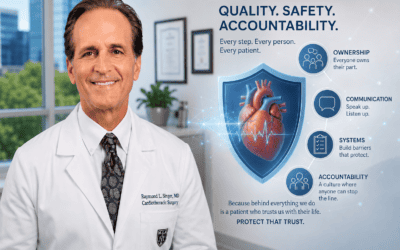
Quality and Patient Safety Must Always Come First
After years of leadership in healthcare quality and patient safety, Dr. Raymond Singer discusses two principles that can help prevent serious safety failures: ownership and communication.
The Power of Culture in Healthcare: Why Great Teams Deliver Better Care
In healthcare, metrics tell only part of the story. The culture behind a program shapes how people communicate, collaborate, hold one another accountable, and ultimately care for patients.
Featured
Pages
- Learn about heart valves. Heart Valves
- Read testimonials. Testimonials
- Did you know I have a consulting firm? Singer Heart/Lung Consulting
- Check out my TedTalk! Defining Success
Links
- Links page with more information about your heart. Links
- Dr. Adam Pick's Site: heart-valve-surgery.com