Today I’d like to share an important health update about Cyclospora, a microscopic parasite that is causing an increasing number of illnesses across the United States.
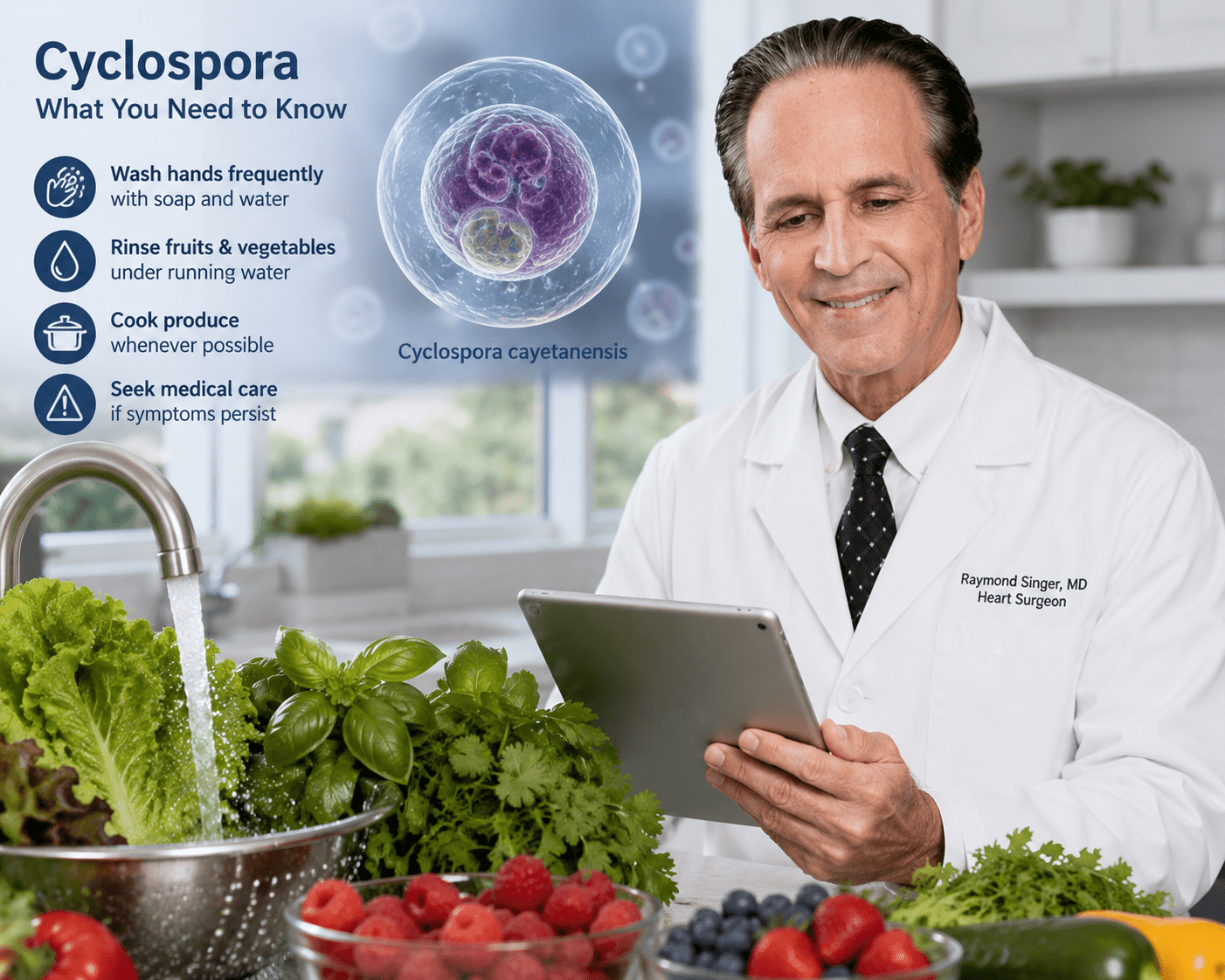
Although investigators are still working to identify the current source, previous outbreaks have most often been linked to fresh produce rather than meat or dairy products. Foods associated with past outbreaks include fresh basil, cilantro, leafy greens, bagged salads, raspberries, other berries, raw vegetables, and fresh herbs.
Symptoms of Cyclospora
Symptoms usually begin about one week after exposure and may include:
- Profuse, watery, sometimes explosive diarrhea
- Severe abdominal cramping
- Nausea and vomiting
- Loss of appetite
- Fatigue
- Weight loss
One important characteristic of Cyclospora is that it typically does not resolve within 24 hours. Symptoms may come and go for several weeks if left untreated.
How to Reduce Your Risk
You can lower your risk by following several simple food safety practices:
- Wash your hands thoroughly with soap and water before and after preparing food.
- Rinse fresh fruits and vegetables under running water.
- Remove damaged outer leaves from produce when appropriate.
- Cook produce whenever possible.
It’s also important to know that alcohol-based hand sanitizers and many produce rinses do not reliably kill Cyclospora, making proper washing especially important.
Treatment
The good news is that Cyclospora infection is treatable.
The preferred antibiotic is trimethoprim-sulfamethoxazole (TMP-SMX), commonly known as Bactrim® or Septra®. Most patients improve quickly once appropriate treatment begins.
Patients with a sulfa allergy should discuss alternative treatment options with their healthcare provider, as there is no single equally effective standard alternative.
Why Heart Patients Should Be Especially Careful
For older adults and people with heart disease, severe diarrhea can quickly lead to dehydration.
This is especially important if you take blood pressure medications, diuretics, or medications for heart failure. Significant dehydration can:
- Lower blood pressure
- Reduce kidney function
- Disrupt important electrolytes such as potassium and magnesium
- Increase the risk of abnormal heart rhythms
If you develop persistent diarrhea, dizziness, difficulty keeping fluids down, a rapid heartbeat, or symptoms that last more than a day or two, contact your healthcare provider promptly. Seek emergency medical care if you become weak, confused, or are unable to stay hydrated.
The good news is that most people recover completely, particularly when the infection is recognized early and treated appropriately.
Stay informed, stay hydrated, and stay healthy.
Interested in my book? You can buy it on Amazon!
(𝘛𝘩𝘦 𝘷𝘪𝘦𝘸𝘴 𝘦𝘹𝘱𝘳𝘦𝘴𝘴𝘦𝘥 𝘪𝘯 𝘮𝘺 𝘱𝘰𝘴𝘵𝘴 𝘢𝘳𝘦 𝘮𝘺 𝘰𝘸𝘯 𝘢𝘯𝘥 𝘥𝘰 𝘯𝘰𝘵 𝘳𝘦𝘱𝘳𝘦𝘴𝘦𝘯𝘵 𝘵𝘩𝘦 𝘷𝘪𝘦𝘸𝘴 𝘰𝘧 𝘮𝘺 𝘦𝘮𝘱𝘭𝘰𝘺𝘦𝘳 𝘰𝘳 𝘢𝘯𝘺 𝘰𝘳𝘨𝘢𝘯𝘪𝘻𝘢𝘵𝘪𝘰𝘯.)
Recent Posts

Should We Be Afraid of AI?
Should we be afraid of AI? Dr. Scott Silverstein, a pioneer in medical informatics, shares why human judgment, experience, and responsible innovation matter more than ever.

Extraordinary Care Around the Clock
While most of us are sleeping, the cardiac surgery night crew at Jefferson Einstein Montgomery Hospital is working tirelessly to keep patients safe, supported, and cared for. Their dedication, compassion, and teamwork make extraordinary care possible around the clock.

Not Every Patient With Aortic Stenosis Is Best Served by the Least Invasive Approach
Not every patient with aortic stenosis is best served by the least invasive approach. For this 68-year-old patient, severe aortic stenosis and critical coronary artery disease made surgical valve replacement and CABG the right choice.

When the Right Heart Valve Changes: A Fourth Operation After 14 Years
A patient’s remarkable valve history led to a fourth open-heart operation, not because her mechanical valve failed, but because her medical circumstances changed.

Sleep Apnea and Your Heart: Why Your Sleep Matters
Sleep apnea isn’t just about snoring or feeling tired. Untreated sleep apnea can put stress on the cardiovascular system, making sleep an important part of taking care of your heart.

Congratulations to Anastasia Arce, PA-C, on the APC Excellence Award
Congratulations to Anastasia Arce, PA-C, on receiving the Jefferson Health APC Excellence Award. Anastasia is an invaluable member of our Cardiac Surgery team, and this recognition is so well deserved.
Featured
Pages
- Learn about heart valves. Heart Valves
- Read testimonials. Testimonials
- Did you know I have a consulting firm? Singer Heart/Lung Consulting
- Check out my TedTalk! Defining Success
Links
- Links page with more information about your heart. Links
- Dr. Adam Pick's Site: heart-valve-surgery.com