
Total Major Operations Performed by Dr. Singer
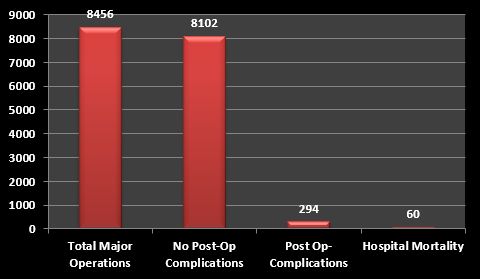
Data Current Through June 21, 2026
Breakdown of Dr. Singer’s Cases by Category
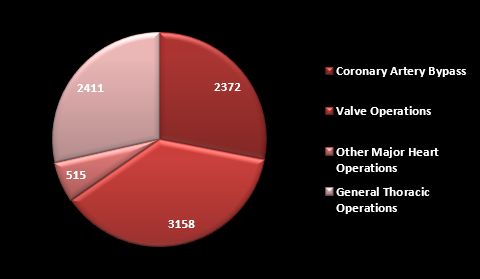
Data Current Through June 21, 2026
Dr. Singer’s Coronary Artery Bypass Surgery Results
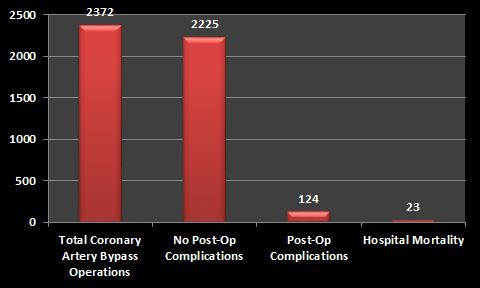
Data Current Through June 21, 2026
Dr. Singer’s Total Valve Surgery Results
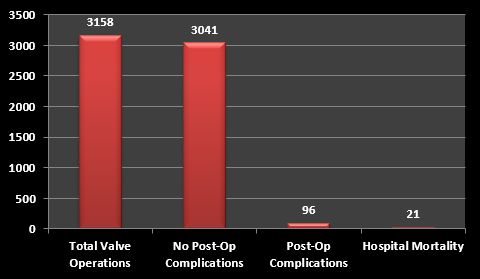
Data Current Through June 21, 2026
The percentage of valve operations performed by me has increased steadily since 1999, after traveling to London and Paris to learn advanced aortic valve and mitral valve techniques.
Dr. Singer’s Isolated Mitral Valve Repair Surgery Results
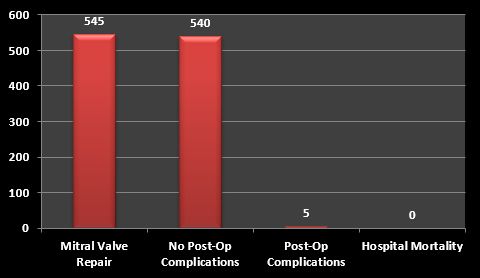
Data Current Through June 21, 2026
Dr. Singer’s General Thoracic Surgery Results*
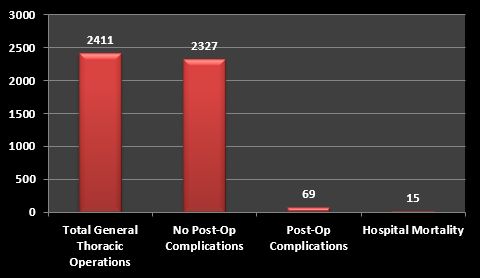
Data Current Through June 21, 2026
*The term “General Thoracic Surgery” refers to major lung, esophageal, and chest wall procedures.
Nothing can be more important than knowing the experience level of your surgeon. Generally speaking, the more you do something, the better you become! Since entering practice in 1992, I have performed over 8,351 major heart and lung operations and numerous minor bedside procedures.
Along with being one of the busiest heart valve surgeons in the country, over the years I have consistently had the best outcomes… not by a little, but by remarkable stats.
Experience is the most important quality you need in a surgeon. It is crucial that you ask your surgeon the following key questions:
- How many years have you been in practice?
- How many of these procedures have you performed in the past 2 years?
- How many total procedures do you perform?
- And, most importantly, what are your outcomes?
If your surgeon cannot answer these questions, or if your surgeon is unwilling to answer these questions, then you are in the wrong office! And, guess what, you DO NOT need to have your surgery done by the surgeon your physician recommended. You DO have the right for a second opinion, including if that opinion needs to be at a DIFFERENT hospital network!
It sickens me that patients are led to believe that they do not have a choice. Many patients come to me from other hospital networks, including those with heart surgery programs. That’s because more and more patients are using the Internet and demanding “second opinions.” You should demand a second opinion as well, as I discuss in the video HERE.
Pennsylvania Health Care Cost Containment Council (PHC4) Results
You can go to the Pennsylvania Health Care Cost Containment Council (PHC4) at www.phc4.org to obtain yearly results. PHC4 is an independent state agency formed in order to address the rapidly growing health care costs. PHC4’s first report was published on November 20, 1992. Many surgeons view “report cards” with skepticism; however, I personally believe that public reporting of surgeons’ outcomes is very important. As a result of the success of the PHC4’s reporting, hospitals across the state quickly began to look at their internal processes for credentialing heart surgeons, ensuring proper training and quality.
Among other observations, the PHC4 report suggests that higher volume surgeons have better outcomes. This makes sense, of course. The more you do something, the better your experience, and likely the better your outcomes.
Since the first reporting of heart surgeons outcomes in Pennsylvania in 1992, the mortality rate for coronary artery bypass and valve surgery has dropped dramatically. The fact is, report cards change behavior and I applaud PHC4 for their reporting efforts. While report cards don’t tell you everything about a surgeon or hospital, they do provide a lot of important information. More importantly the public reporting of surgeons’ outcomes provide an incentive for surgeons and hospitals to focus on quality and service.
These reports –PHC4, Consumer Reports, US News and World Report– are widely distributed and are available to insurance companies, businesses, and consumers alike. No doubt, having good data is important and relevant. I encourage surgeons to become engaged in the reporting process and in doing so, improve their outcomes for our patients.
Below are charts listing my personal experience and outcomes for all of my major heart and lung procedures. I will be updating the data every few months in order to keep you informed of my results. As I said above, when seeking a surgical opinion it is important to ask your surgeon for his or her results.
If your surgeon cannot or will not provide you with his or her results, you should NOT let that surgeon operate upon you or our family. Always ask for a second opinion.